
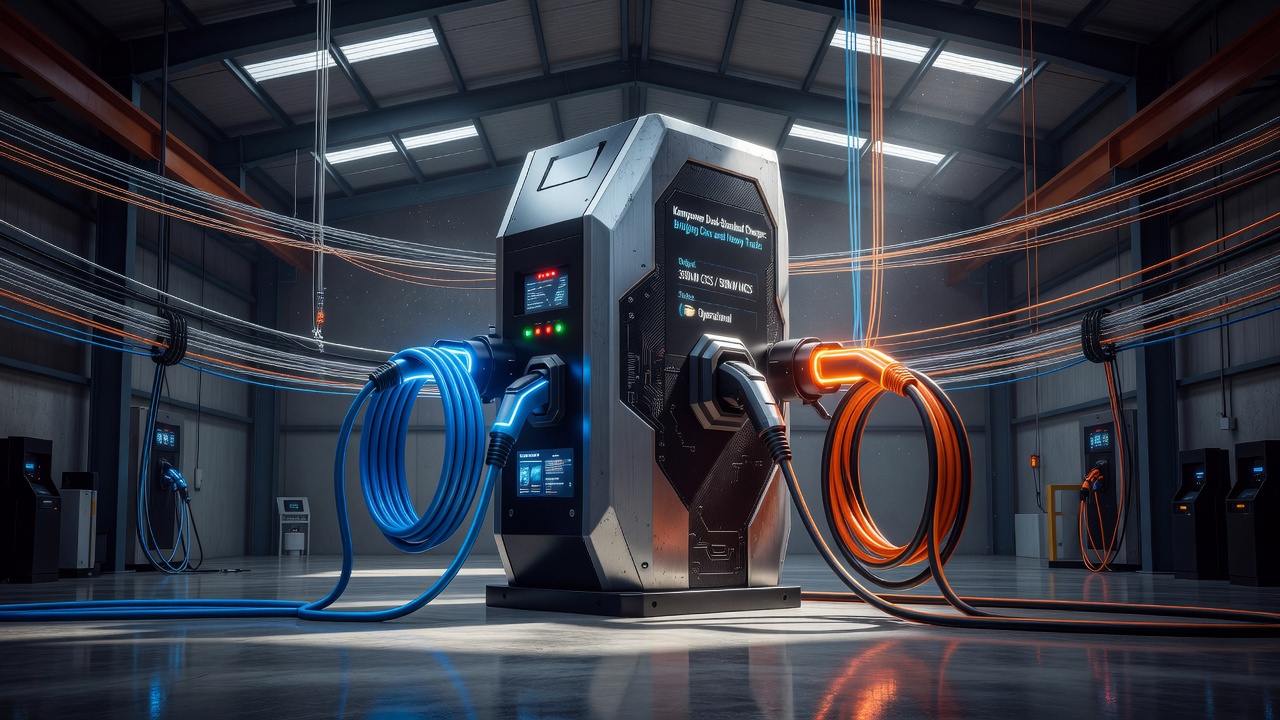
A single charging dispenser that can fuel a passenger car and a heavy-duty truck without separate infrastructure is no longer a concept - it's a product. Kempower has introduced the Mega Satellite Flex, a high-power charger capable of delivering up to 560 kW through the established CCS standard or up to 1.2 MW through the emerging Megawatt Charging System (MCS). The unveiling took place at the company's Unplug & Recharge event, held alongside ACT Expo this week, and the unit is slated for release in North America and Europe in July 2026.
Why One Charger Now Serves Two Standards
The electric vehicle charging landscape has long been split by vehicle class. CCS became the dominant standard for passenger cars and light commercial vehicles, while heavy-duty trucks - which require dramatically more energy to cover long distances - have pushed the industry toward MCS, a newer specification designed to handle megawatt-level power safely. Kempower's decision to support both standards in a single dispenser reflects a practical reality: charging site operators do not want to build, permit, and wire two separate systems when one flexible unit can do the work. The same logic that applies to home network security - where consolidating protections rather than patching them piecemeal reduces risk and cost - applies here to physical charging infrastructure. Just as understanding how a VPN protects a smart home shows the value of a unified layer of protection across multiple connected devices, a unified charging platform protects an operator's investment across multiple vehicle types.
Technical Specifications and Practical Impact
The Mega Satellite Flex is built to handle serious current: up to 1,500 amps for MCS and 700 amps for CCS. Cable lengths are 5 meters for CCS connections and 2.7 meters for MCS, dimensions chosen to accommodate the physical realities of trucks and cars parking at the same site. An optional payment terminal is available, and the unit is compatible with Kempower's existing distributed charging architecture, meaning operators already using Kempower systems can add the Mega Satellite Flex without redesigning their sites from the ground up. It also supports 800-volt vehicle architectures, an increasingly common feature in newer EVs designed for faster charging sessions.
What This Means for Charging Economics
Utilization is the central economic problem for public charging infrastructure. A dispenser sitting idle earns nothing, and building redundant hardware for different vehicle classes multiplies that risk. By letting one site serve both cars and trucks from installation day, Kempower is betting that operators will see faster returns on capital and fewer stranded assets as MCS adoption grows over the coming years. For now, CCS remains the practical backbone of most public charging, but as electric trucking fleets scale up, chargers that can flex between formats may become the standard expectation rather than a competitive edge.