
How Super-Rich Features Deliver Advanced Functionality, High-End Capabilities, and a Premium User Experience with a Robust Feature Set
A product with forty settings and a product with four can serve the same customer, yet the one with forty almost always commands a higher price and a longer retention curve. That gap is not accidental. It reflects a deliberate design philosophy where every added capability earns its place by solving a real problem, not by padding a spec sheet.
This is where the idea of super-rich features starts to matter beyond marketing language. When a platform layers genuine depth onto its core function, the effect compounds: customization options multiply, automation reduces manual effort, and the interface still feels coherent rather than cluttered. Developers who study this pattern often point to platforms showcasing super rich features as a useful reference point, since the design logic behind layered functionality translates across industries, from finance software to entertainment platforms. The lesson is consistent regardless of sector.
What follows examines how this depth gets built, why it changes user behavior, and what separates a feature-rich product from one that merely looks busy. The distinction matters because the wrong kind of complexity drives users away, while the right kind keeps them engaged for years.
What Makes a Feature Set Truly Rich
A rich feature set is not defined by quantity. A product with twelve well-integrated tools can outperform one with fifty disconnected options. Richness comes from how features relate to each other, how they anticipate user needs, and how much friction they remove from a workflow.
Depth Versus Breadth
Breadth means covering many use cases superficially. Depth means solving fewer problems completely. The strongest products balance both, offering broad coverage while going deep in the areas users care about most. A robust feature set typically prioritizes depth in core functions and breadth in secondary ones, so the primary task always feels fully supported.
Integration Over Accumulation
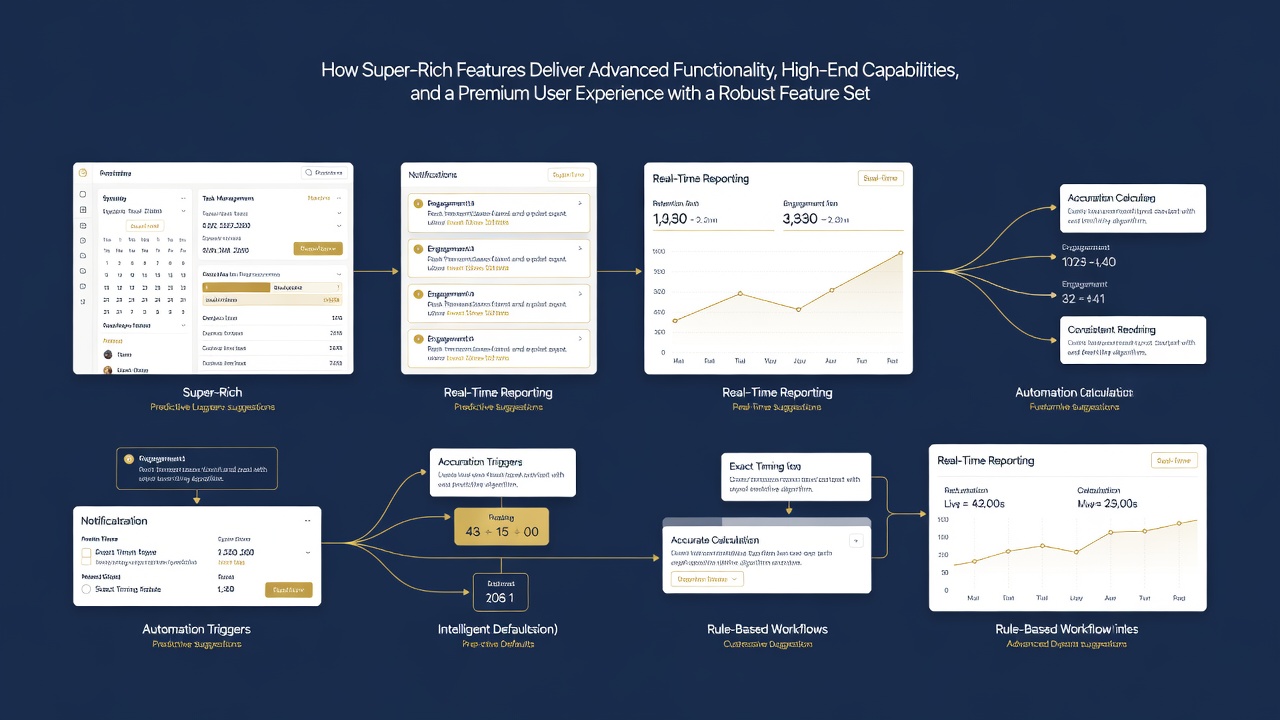
Features that talk to each other create compounding value. A calendar tool that syncs with task management, notifications, and reporting delivers more than three separate tools bundled together. This interconnection is what turns a list of capabilities into advanced functionality that users actually rely on daily.
Signals of Genuine Richness
- Features solve problems the user did not explicitly ask about but recognizes once shown
- Advanced options remain hidden until needed, avoiding clutter for casual users
- Customization scales with user skill level rather than overwhelming beginners
- Updates add refinement to existing tools, not just new unrelated ones
Advanced Functionality as a Competitive Differentiator
Functionality becomes a differentiator when competitors offer the basics and one product offers noticeably more control, speed, or precision. This gap is often what separates a market leader from a commodity alternative.
Automation and Intelligent Defaults
Automation reduces the number of decisions a user must make manually. Smart defaults, predictive suggestions, and rule-based triggers all fall under this category. The best implementations feel invisible: the user notices the outcome, not the mechanism.
Customization Without Complexity
Advanced functionality should expand what a user can do without expanding what they must learn first. Layered menus, progressive disclosure, and contextual settings allow power users to dig deep while newcomers stay on the surface comfortably.
Scalability of Features
A function that works for ten users must still work for ten thousand. Scalable functionality maintains speed and accuracy regardless of load, which is why performance testing under stress conditions is inseparable from functional design.
High-End Capabilities That Set Products Apart
High-end capabilities usually address the top tier of user needs: precision, security, speed, or exclusivity. These are the features that rarely appear in entry-level alternatives because they require significant engineering investment.
Precision Engineering in Core Functions
Precision shows up in details users notice only when they are absent: exact timing, accurate calculations, consistent rendering. High-end products treat these details as non-negotiable rather than optional polish.
Security and Reliability at Scale
Capabilities like end-to-end encryption, redundant backups, and real-time monitoring separate premium infrastructure from basic offerings. Reliability under pressure is a capability in itself, not a byproduct of good luck.
Exclusive Access and Tiered Value
Some high-end capabilities exist specifically to reward loyal or paying users with faster processing, priority support, or expanded limits. This tiered structure lets a single platform serve multiple audience segments without diluting the experience for any of them.
Premium User Experience: Where Design Meets Depth
Feature depth without design discipline creates confusion. A premium user experience translates complex capability into something that feels effortless, which requires as much design skill as engineering skill.
Interface Clarity Under Complexity
The more a product can do, the harder it becomes to keep the interface legible. Visual hierarchy, consistent iconography, and predictable navigation patterns allow users to access advanced tools without feeling lost.
Speed and Responsiveness as Experience Factors
Users judge experience quality partly through latency. A feature-rich product that lags feels worse than a simple one that responds instantly. Performance optimization is therefore inseparable from experience design, not a separate engineering concern.
Emotional Trust Built Through Consistency
Trust grows when a product behaves predictably across sessions. Consistent behavior, honest error messages, and stable performance build the kind of confidence that turns casual users into long-term advocates.
Building a Robust Feature Set: Design Principles
Turning ambition into a coherent product requires discipline. Teams that build lasting feature sets follow patterns that prevent bloat while still expanding capability.
Prioritization Frameworks
Not every requested feature deserves a place in the product. Effective teams rank potential additions by user impact, engineering cost, and long-term maintainability, rejecting ideas that look impressive but add little practical value.
Modular Architecture
Building features as independent modules allows teams to add, remove, or update capabilities without destabilizing the rest of the system. This modularity is often what allows a product to keep growing its feature set for years without a full rebuild.
Continuous User Feedback Loops
Feature richness should be validated against real usage data, not assumptions. Regular feedback cycles reveal which capabilities are underused, which need refinement, and which should be removed entirely to keep the product sharp.
Measuring the Impact of Rich Features on User Retention
Feature depth only matters if it changes behavior. Products with strong retention rates typically show a direct correlation between the breadth of their capabilities and how long users stay engaged.
Engagement Metrics That Matter
Session frequency, feature adoption rate, and time spent within advanced tools all indicate whether rich functionality is actually being used or simply sitting unused in a menu.
Churn Reduction Through Capability Expansion
Users often leave a product not because it lacks basic function, but because a competitor offers more depth for the same price. Expanding capability strategically can directly reduce churn by closing that competitive gap before users go looking elsewhere.
Frequently Asked Questions
How do I know if a feature set is genuinely rich or just cluttered?
Test whether removing a feature would noticeably hurt the core workflow. If most features could disappear without affecting daily use, the set is cluttered rather than rich. Genuine richness shows measurable adoption across a wide share of active users.
Can advanced functionality hurt the user experience?
Yes, when it is exposed without proper hierarchy or context. Advanced tools should stay accessible but not dominant, appearing only when relevant to the user's current task rather than cluttering every screen by default.
What is the difference between high-end capabilities and premium pricing?
High-end capabilities refer to actual technical depth, such as security, speed, or precision. Premium pricing is a business decision that may or may not reflect that depth. A product can charge premium rates without delivering genuinely advanced capability, which usually damages trust over time.
How often should a robust feature set be updated?
Update cycles should follow user feedback and technical necessity rather than a fixed calendar. Meaningful updates that refine existing tools tend to build more trust than frequent minor releases that add little practical value.
Do smaller products need rich features to compete?
Not necessarily. Smaller products often succeed by mastering one narrow function extremely well rather than trying to match larger competitors feature for feature. Depth in a single area can outperform shallow breadth across many.
What role does customer support play in a premium user experience?
Support acts as a safety net for complex functionality. Even well-designed advanced features occasionally confuse users, and responsive, knowledgeable support turns those moments into trust-building interactions rather than sources of frustration.